


Tranexamic Acid vs 377 vs Niacinamide: Which One Should You Choose?
Release time:
2025-08-15
When it comes to skincare ingredients that target dark spots and uneven skin tone, three names often appear on product labels: Tranexamic Acid, 377, and Niacinamide. They work differently, but all aim to make skin look brighter and more even. Let’s break down what each one does and how they compare.
Tranexamic Acid
What it is: Originally used as a medicine to stop bleeding, Tranexamic Acid has been found to help with skin discoloration, especially melasma and stubborn dark spots.
How it works: It reduces skin inflammation and slows down the transfer of melanin (the pigment that makes skin darker) to the skin’s surface.
Best for: People with melasma, post-inflammatory hyperpigmentation (PIH), or redness-prone skin.
Texture & feel: Usually found in serums or creams; feels light and gentle.
Time to see results: Around 8–12 weeks of consistent use.
377 (Phenylethyl Resorcinol)
What it is: A lab-made antioxidant that is one of the most powerful brightening agents on the market.
How it works: It blocks tyrosinase, the main enzyme responsible for producing melanin. Studies show it can work faster and stronger than some traditional whitening ingredients.
Best for: People looking for fast results and a strong effect on dark spots.
Texture & feel: Usually combined with other brighteners in lightweight serums; can be slightly more potent, so sensitive skin should patch-test first.
Time to see results: As soon as 4–6 weeks with regular use.
Niacinamide
What it is: Also known as Vitamin B3, it’s a versatile ingredient with multiple skin benefits.
How it works: It reduces melanin transfer, strengthens the skin barrier, regulates oil, and smooths fine lines.
Best for: Most skin types, but high concentrations (≥10%) can cause warmth, redness, or stinging, especially in very sensitive skin. Using lower concentrations (<5%) improves tolerance.
Texture & feel: Found in serums, creams, and toners; generally lightweight, but patch-testing is advised for sensitive skin.
Time to see results: Around 8–12 weeks of consistent use.
Side-by-Side Comparison
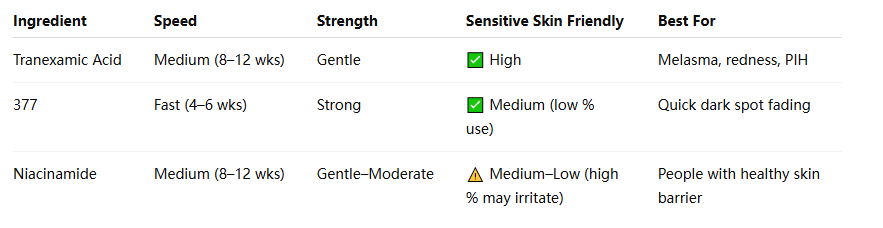
If you have sensitive skin → Start with Tranexamic Acid or low-concentration 377.
If you want fast results and can tolerate stronger ingredients → Try 377.
If you want overall skin benefits → Use Niacinamide at a safe concentration, especially if your skin barrier is healthy.
For stubborn pigmentation → A combination of Tranexamic Acid + Niacinamide or 377 + Niacinamide can be effective. But pay attention to the concentration, order and tolerance of sensitive skin.
Final Tip
Always pair these brightening ingredients with daily sunscreen. Without sun protection, melanin production will continue, and dark spots will come back no matter how good your serum is.
Choose tranexamic acid raw materials produced in pharmaceutical factories and contact Focusfreda for more information.

BLOGS

See You in Paris! Focusfreda Brings the "HA+" to in-cosmetics Global 2026
Join Focusfreda at in-cosmetics Global 2026 (Booth 2S59) in Paris. Discover our "HA+" philosophy and new biotech breakthroughs: Copper Lysinate Hyaluronate and Lysine Hyaluronate for sustainable, high-performance skincare.

Discover why the combination of Sodium Polyglutamate (Gamma-PGA) and Hyaluronic Acid (HA) is the new gold standard in professional skincare. Explore the science of the 3D Moisture Matrix and Focusfreda’s green bio-fermentation technology.

Explore the synergistic benefits of oral Sodium Hyaluronate and Ergothioneine (EGT). Learn how EGT stabilizes HA via the OCTN1 transporter to prevent oxidative degradation, enhancing bioavailability in next-generation longevity dietary supplements for 2026.

Good Breakthrough | FocusFreda Secures First NCI Registration for "Lysine Hyaluronate"
FocusFreda achieves a skincare milestone with the China NMPA registration of Lysine Hyaluronate (NCI No. 20260026). This innovative "Hyaluronic Acid+" ingredient combines essential amino acid for superior skin affinity, enzymatic stability, and synergistic repair. Explore how FocusFreda is leading the global shift toward high-end, science-backed green beauty solutions.

Knee osteoarthritis (KOA) is a common chronic joint disease with an increasing prevalence among older adults, severely impacting quality of life. Sodium hyaluronate (SH), as a core component of synovial fluid, is a key drug in KOA treatment. However, different molecular weights of SH exhibit significant differences in efficacy and mechanism of action, directly affecting treatment options. This article focuses on interpreting its differentiating effects to provide a reference for clinical application. [Reference Interpretation: Figure 1]

Is Hyaluronic Acid Ingredient Good for Acne? Safe Hydration for Breakout-Prone Skin
Learn whether hyaluronic acid is good for acne-prone skin, if it clogs pores, how it supports the skin barrier, and how to pair it with retinoids, niacinamide, and BHA—plus routine tips and FAQs.